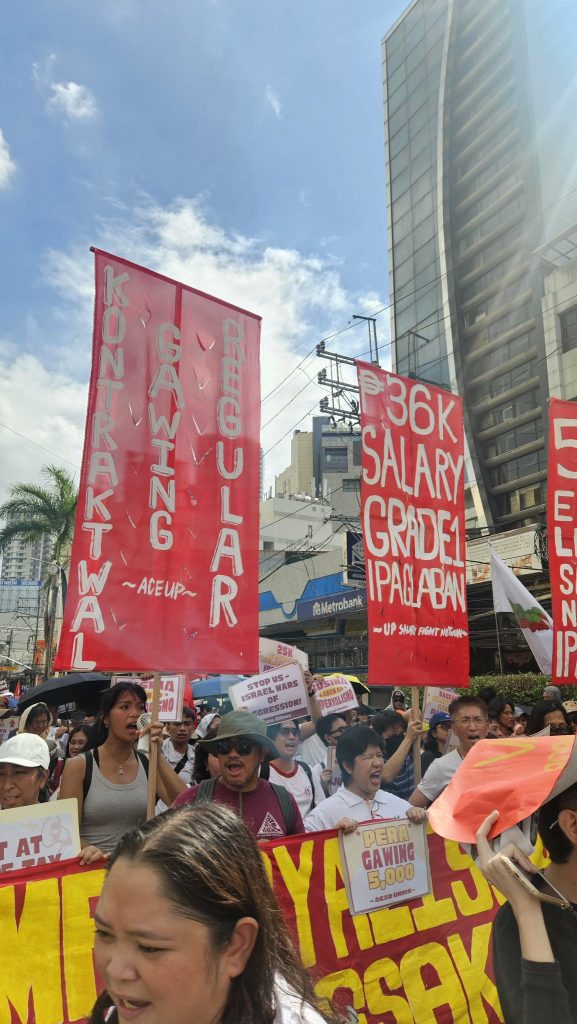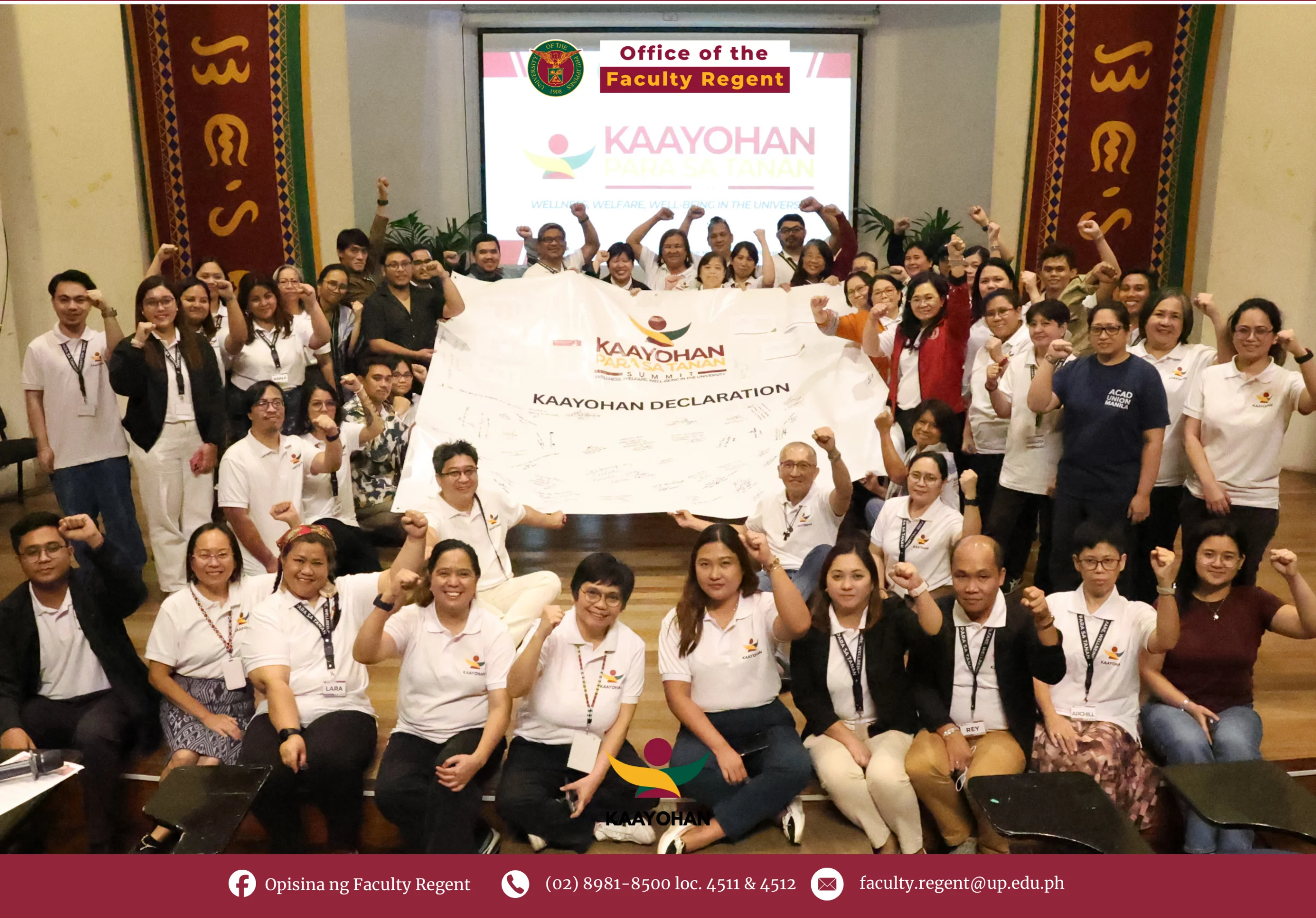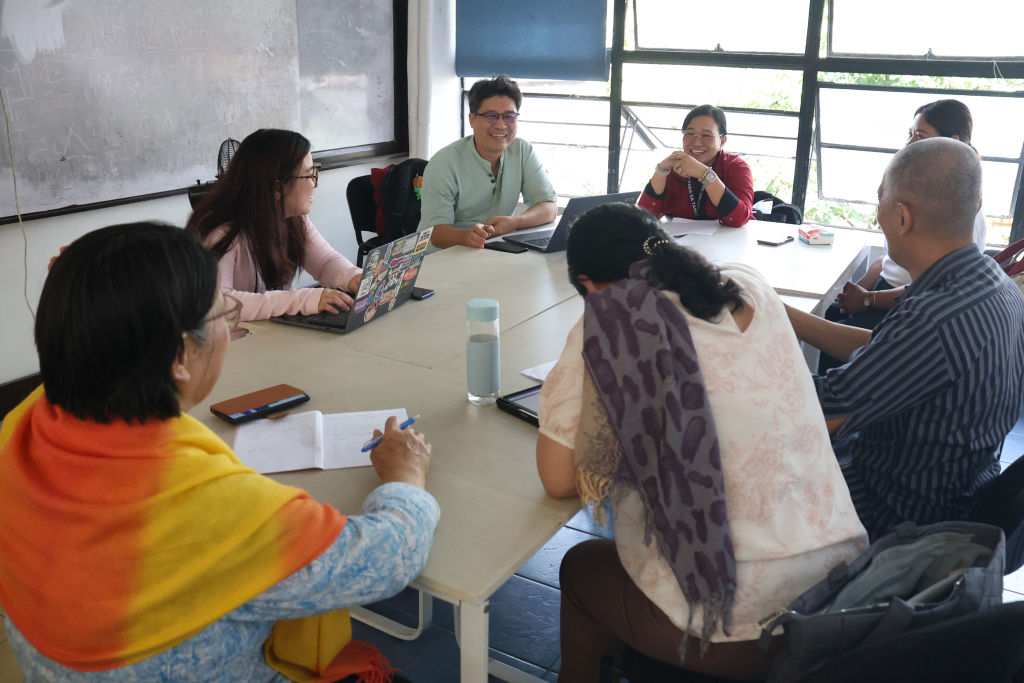
The Board of Regents (BOR) is the highest decision-making and governing body of the University of the Philippines (UP) System.
Five of the regents sit in the BOR as ex-officio members by virtue of the offices they hold. These are the CHED Chairperson (board chair), UP President (board co-chair), chair of the Senate Committee on Higher, Technical and Vocational Education, chair of the House Committee on Higher and Technical Education, UP Alumni Association (UPAA) president (Alumni Regent). Three other regents, also called “Malacañang Regents” are appointed directly by the President of the Philippines. Only three of the 11 members are elected or chosen by their constituencies through democratic processes. These are the Student Regent, Faculty Regent, and Staff Regent.
R.A. 9500 recognizes that the processes for the selection of all sectoral regents should be sector-led and administered. However, in contrast with the other sectoral regents, the process for the selection of the Faculty Regent is currently administered by the Office of the Vice President for Academic Affairs (OVPAA) and all relevant memoranda emanate from the Office of the President (OP) of the University.
A further contrast should be observed in relation to other state universities and colleges (SUCs), where, in accordance with R.A. 8292, the position of Faculty Regent is also an ex-officio position automatically filled by the faculty chair/head/ president of the duly recognized academic association or union.
The internal democratic processes by which these unions and associations elect their leaders are fully independent, autonomous, and shielded by law from any interference or meddling by the university administration. The appointment of the president of the UP Alumni Association (UPAA) as Alumni Regent in the BOR is a process analogous to this. The election of the UPAA President is also a completely autonomous process that the UP administration has no hand in and cannot legally interfere with.
Why, then, is the selection process for the Faculty Regent position, administered as it is by the OVPAA, not completely independent and autonomous as is the case for the Student Regent, Staff Regent, and the Alumni Regent? Indeed, why is UP also an exception in this particular aspect of democratic governance as compared to other SUCs?
The question of UP administration interference, quite heavy-handed this time, has become an issue once again with UP President Jimenez’ decision to unilaterally extend the nomination period and revise the timetable for the ongoing Faculty Regent selection process.
The BOR has previously extended the search processes for deans and chancellors beyond the originally set deadlines. These extensions, typically done over the heads of the search committees mandated to oversee the respective processes, have usually been decided by the BOR based on recommendations from the UP President.
These extensions by the UP President have sometimes been quite controversial.
In 2022, former UP President Danilo Concepcion, with the approval of the BOR, extended the search process for the chancellorship of UP Cebu and reconstituted the search committee. Though there were already three candidates running for the position, Pres. Concepcion asserted that the “pool of candidates” should be widened. After the extension, the candidate eventually chosen as chancellor by the BOR was not among the original list of qualified candidates who had complied with the original deadline.
Pres. Concepcion’s argument for a “wider pool” went against the fact that during his term, there were cases of three candidates for chancellorship that went through the BOR without any extension: UP Mindanao Chancellorship (2019); UP Los Baños Chancellorship (2020); UP Visayas Chancellorship (2020). In fact, having three candidates running for the position of chancellor is quite typical.
In 2024, President Jimenez extended the search for the UP Baguio Chancellor purportedly because there was only a single nominee. The BOR appointed the candidate who had filed after the extension and not the candidate who had duly filed before the original deadline set by the search committee. Pres. Jimenez claimed to have ordered the extension because, according to him, the BOR preferred to have multiple nominees to choose from.
Nevertheless, when only a lone nominee ran for the Chancellorship in UP Manila in 2026, no issues were raised and the BOR proceeded with the process of appointing the lone nominee. Other precedents include the reappointment in 2020 by the BOR of a lone candidate, once again, for the UP Manila Chancellorship (who was, on top of this, a third-termer). No objection to this lone nominee situation was recorded on the part of Regent Jimenez, then a BOR member.
The UP Cebu and UP Baguio cases therefore reveal a selective application of what are sometimes claimed, perhaps when convenient, to be general principles guiding the decisions of the President and the BOR. In this regard, one should point out two things: (1) The fact that in these two cases, leading candidates for the position were recognized academics who also happened to be associated with the union; (2) The end result is that the candidates subsequently chosen by the BOR had filed their candidacy only after the extension of the deadlines originally set by the duly constituted search committees.
This raises legitimate questions regarding transparency, arbitrariness, as well as suspicions pertaining to the underlying preferences of the UP President and the BOR as to who is acceptable for the Chancellorship of each UP Constituent University and whether union members and officials have been unjustly subjected to discrimination in these previous cases.
There is a fundamental and major difference, however, between the selection of chancellors and sectoral regents. Despite all efforts by university constituencies to have their voices heard in the chancellor selection processes, in the end, the choice is ultimately decided by majority votes among the regents in the BOR. The votes of the three sectoral regents representing community sentiments and concerns are few in comparison to the other members of the BOR. The sectoral regents are therefore frequently outvoted.
The selection of sectoral regents follows a different principle from that of the chancellors. In this case, it is not the right of the BOR or the UP administration through the UP President to make any final choices. Even if R.A. 9500 is not explicit regarding the manner of democratic selection or election of the sectoral regents, it is quite unambiguous in safeguarding the role of each constituency in determining the “rules and qualifications” that will govern the selection of their sectoral representatives. In the case of the Faculty Regent, the rules and qualifications must be “approved” in all cases by the university councils of the CUs.
The UP System Committee for the FR selection process convened by Office of the UP Vice President for Academic Affairs (OVPAA) has been the mechanism by which the constituent university councils have approved the “rules and qualifications” for the process of selection or election of the FR.
The fact that the OVPAA should be involved in this process is not stated in R.A. 9500 and may even violate the spirit of the law. Ideally, the process should be independent from any interference by the UP administration, as in the case of the Student and Staff Regent elections.
In fact, there is no reason why the Office of the Sectoral Regents should not be in charge of this process. Given this non-ideal situation, the academic union duly asserts the right of representation in the System Committee for the selection of the Faculty Regent for the sake of basic transparency and accountability.
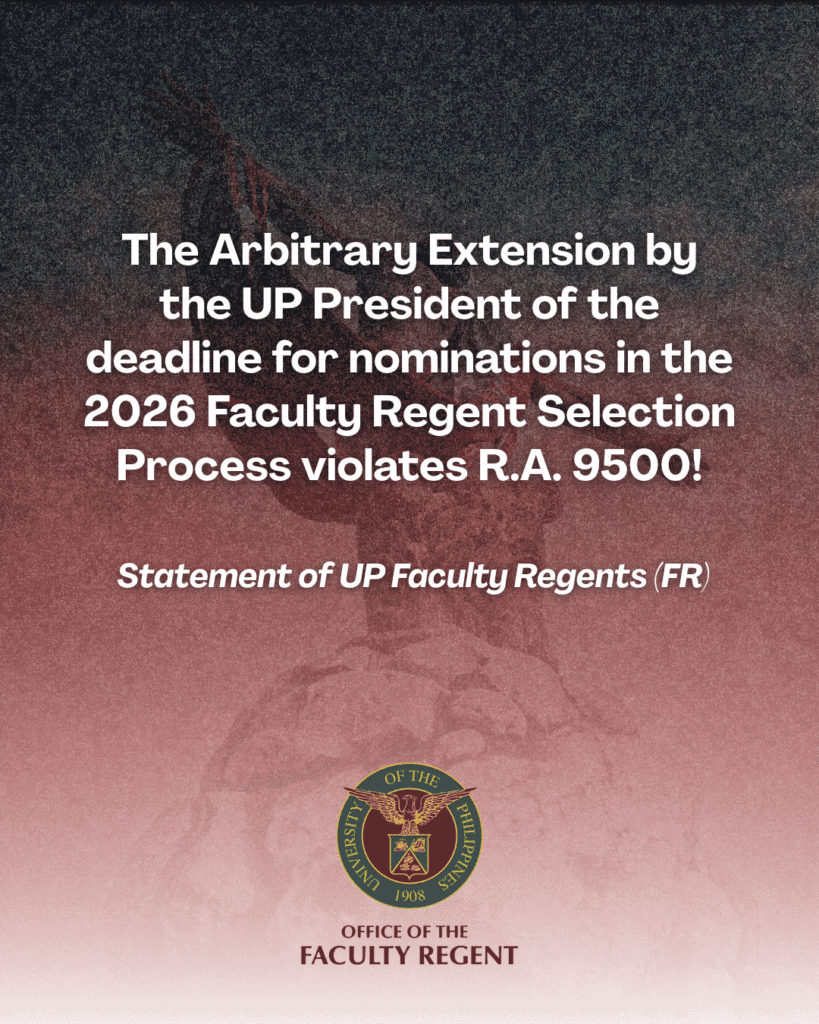
Undermining the democratic nature of the Faculty Regent selection process, UP President Angelo Jimenez has directly violated R.A. 9500 in unilaterally revising and extending the timetable for the ongoing selection process (Memorandum No. PAJ 26-21) without even consulting or informing the mandated UP System Committee.
R.A. 9500 states that “rules and qualifications” governing the process of Faculty Regent selection should be approved by the constituent university councils as these are presumably adequately represented in the UP System Committee.
“Rules” here must, of necessity, include the setting and determination of the terms of compliance with the relevant timetables and deadlines for the selection process. In his justification for the extension, President Jimenez emphasized that an “engaged constituency is critical to ensuring integrity, accountability, and meaningful participation in university governance.”
No one will object to this, but, as stated in R.A. 9500, it is not up to the UP President to unilaterally change the rules governing the process without the approval of the constituent university councils and other representatives in the UP System Committee convened for the purposes of the FR selection.
R.A. 9500 recognizes that the selection of the sectoral regents, being democratic processes, should be safeguarded from all forms of interference from the UP administration. This is the reason why it clearly states that the “rules and guidelines” to be implemented in the selection process should be approved by the university councils composed of faculty members, or their representatives. The UP President cannot simply override this process on his own. Any such direct interference by the UP President risks undermining the integrity and credibility of the process of selection. The lack of transparency and perceived arbitrariness of the present decision to extend the deadline for nominations further complicates matters.
It is plainly not up to the UP President or the BOR to set the rules and qualifications for the selection of the Faculty Regent. Any opinion of the UP President regarding the acceptable number of candidates running for the position or regarding their qualifications is irrelevant to the selection process of the Faculty Regent. To think otherwise is to seriously violate and erode the foundations of a pillar of democratic representation in the university. To act otherwise is to gravely abuse one’s authority.
SIGNED:
Roland G. Simbulan, 2006
Judy M. Taguiwalo, 2009-2010
Ramon G. Guillermo, 2019-2020
Aimee Lynn Barrion-Dupo, 2021-2022
Carl Marc L. Ramota, 2023-2024
Early Sol A. Gadong, 2024-2026