Kaayohan Summit 2025: Centering Wellness, Welfare, and Well-being in UP
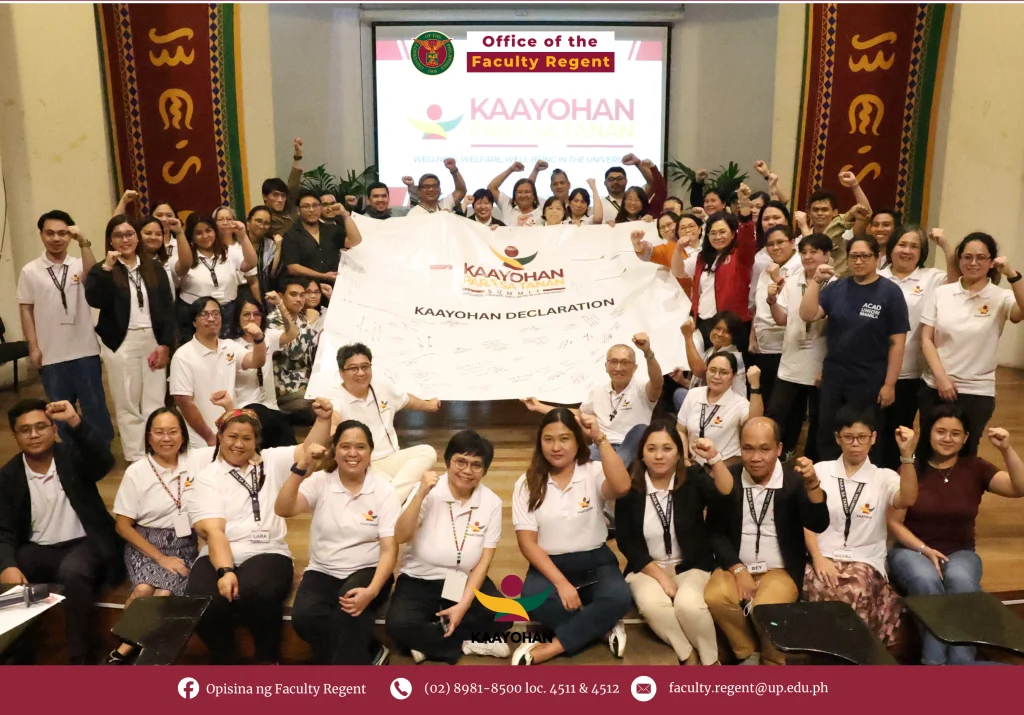
In order for the University of the Philippines (UP) to serve the people well, it has to ensure the wellness, welfare, and wellbeing of its own community. This, in essence, was one of the key messages that came out of the Kaayohan Summit on December 1-2, 2025 at the Melchor Hall Theater, College of Engineering, UP Diliman, Quezon City. Guided by the theme “Kaayohan para sa Tanan: Wellness, Welfare, and Well-being in the University,” the two-day event sought not only to articulate the challenges to well-being experienced by UP’s workforce but also to propose for policies that enable the community to better deliver its indispensable public service to the country. The summit brought together faculty, REPS, administrative staff, and contractual personnel from across the UP System. At the core of the summit was the Kaayohan framework adopted by the UP Office of the Faculty Regent, which emphasizes that honor, excellence, and service rest fundamentally on the well-being of its people. This framework recognizes that a university’s capacity to teach, conduct research, and deliver public service is inseparable from the conditions of its workers. The Summit identified some of the systemic issues faced by the UP community. These include heavy workloads, unclear or unfair promotion pathways, limited institutional support, mobility and housing issues, and persistent job insecurity undermine the university’s mission. By confronting these issues head-on, the summit aimed to advocate for a policy shift toward a healthier and more humane academic environment. The keynote address delivered by Dr. Paul Michael Hernandez of the UP Manila Healthy University Office highlighted the urgency of institutionalizing well-being. He urged the university community to advocate not only for better funding but also for structural commitments that protect worker welfare. Dr. Hernandez called for allocating five percent of UP’s annual budget to health and wellness — similar to the Gender and Development budget requirement. By linking well-being initiatives to systemic funding mechanisms, he emphasized the need for long-term solutions rather than piecemeal efforts. Challenges to well-being The plenary discussions, meanwhile, highlighted the various challenges that undermine the well-being of university personnel. In the first plenary session on wellness, speakers pointed to mental health concerns, unsafe spaces, physical accessibility issues, and the emotional toll of being overworked and undervalued. Prof. Ervina Espina of the UP Ugnayan ng Pahinungod said that there are some unsafe spaces in UP where a “culture of silence” exists. Meanwhile, Prof. Pat Carranza, a mobility advocate and head of the UP College of Music’s Music Education Department, added that the lack of reliable transportation within UP Diliman creates daily hardships, especially for those with mobility concerns. Job insecurity among Job Order/Contract of Service (JO/COS) or contractual workers has been a central concern among the university workforce, said Anna Cruz of the Alliance of Contractual Employees in UP (ACE UP). She emphasized that these employees, who perform essential roles yet lack job stability, must be fully included in the university’s wellness planning. Dr. Shelley Ann Dela Vega added preventive care also needs to be on top of the wellness agenda. She reminded delegates that institutional support for early health interventions can significantly improve long-term outcomes for employees. The role of institutional support in well-being The second plenary discussions during the first day focused on institutional support for welfare. The discussions revealed substantial gaps in career development, compensation, and benefits. Ms. Perlita Raña, national president of the All-UP Academic Employees’ Union (AUPAEU), critiqued the current salary system, asserting that there seems to be a disconnect between employees’ growing expertise and their stagnant pay levels. Staff Regent-elect Rey Espanto, meanwhile, commented that equity remains uneven across constituent universities, urging UP to standardize benefits under the principle of “One UP.” Two UP System officials shared updates on the Angelo Jimenez administration’s efforts to address wellness concerns. Assistant Vice President for Administration Prof. Richard Javier announced a UP-TESDA partnership for free capacity building, while Assistant Vice President for Academic Affairs Ian Kendrich Fontanilla discussed the Office of the Vice President for Academic Affairs’ grants and fellowships, among other things. Well-being and academic freedom During the second day, speakers participated in a plenary session focusing on the importance of academic freedom and how threats to academic freedom impact on the wellness, well-being and welfare of members of the UP community. Former Faculty Regent and UP Manila Prof. Carl Marc Ramota discussed efforts from the faculty community at defending academic freedom in UP in a climate of political repression and red-tagging. He noted the formation of the Committee for the Promotion of Academic Freedom and Human Rights in most Constituent Universities in UP as one of the important developments that need to be seen through in the next coming years. Professors Willy Alangui of UP Baguio and Regletto Imbong of UP Cebu discussed how faculty members and other UP community members in their own CUs faced the various challenges and threats to their exercise of academic freedom. Alangui asserted that academic freedom is of utmost importance in order to achieve Kaayohan. Imbong, meanwhile, cited former UP President Francisco Nemenzo, who said that academic freedom is for those who need it the most – the poor and marginalized sectors of Philippine society. Both emphasized the need for both collective action and solidarity with other sectors of Philippine society as crucial in asserting democratic rights. Ruby Anna Bernardo, national chair of the Alliance of Concerned Teachers (ACT), noted the larger context of the threats to academic freedom and human rights in the country. She gave various examples of how educators, both in the public and private sector, and in all levels, have asserted for salary increases and greater benefits but were targeted with reprisals. Bernardo also noted the successes achieved by such assertions. Synthesizing best practices, proposals Throughout the two-day summit, participants of the various UP CUs participated in workshop discussions in order to consolidate both the common issues they face and formulate proposals grounded in the Kaayohan framework. At the end of the summit’s second day, representatives from the
Faculty Regent holds consultation with UP Diliman basic education faculty on job security, well-being
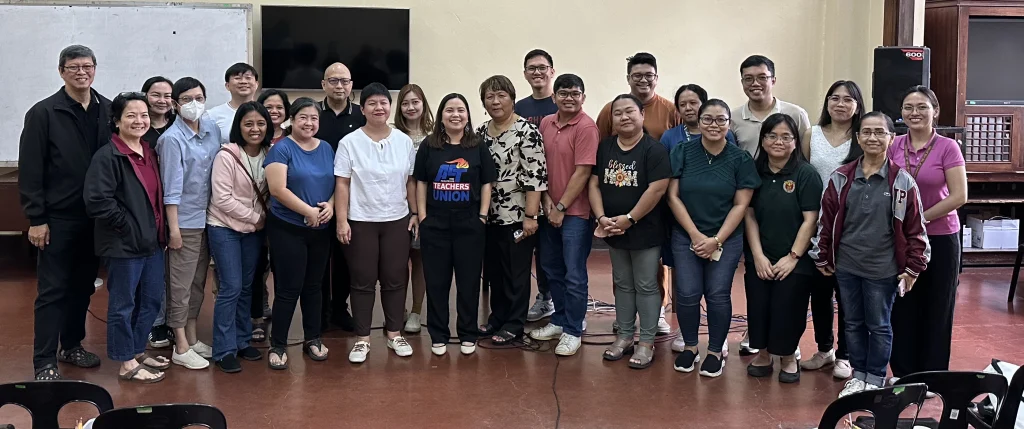
The UP Office of the Faculty Regent (OFR) convened faculty members from the University of the Philippines Integrated School (UPIS) and the UP College of Education for a crucial discussion on their working conditions and welfare. Titled “BATAYAN: Pagbabalita’t Talakayan tungo sa Kaayohan ng UP Basic Education Faculty,” the consultation took place on February 10, 2025, at Room 108, Benitez Hall, UP Diliman, Quezon City. The dialogue underscored the mounting challenges faced by basic education (BE) faculty, including excessive workloads, the rise of contractual employment, and the persistent lack of plantilla (permanent) positions. Participants voiced concerns over job security, economic stability, and the need for stronger academic freedom and democratic governance within the university. Ruby Ana Bernardo, president of the Alliance of Concerned Teachers (ACT) Union-NCR, provided insight into the dire situation of BE teachers across the National Capital Region, highlighting their parallel struggles with UP educators—from work overload and inadequate compensation to the fight for job security. Bernardo also shed light on the alarming cases of red-tagging and vilification faced by ACT Union leaders and members who assert their rights. Despite these threats, the union has made significant strides, successfully negotiating a collective negotiation agreement (CNA) with the Department of Education (DepEd) to uphold the rights and welfare of public school teachers. UP Faculty Regent Early Sol Gadong shared the issues and resolutions raised during the Basic Education Summit held last year and, with Teacher Katrina Paula Ortega, director-at-large of the All UP Academic Employees Union, detailed the specific hardships confronting UPIS faculty, including: Academic Burdens. Heavy workloads, sluggish hiring processes, high attrition rates, and the absence of clear policies on teaching load credits, especially regarding research expectations. Faculty Well-being. Lack of mental health support and inadequate workplace conditions that exacerbate the mental toll of overwork. Economic Security. Delayed salary releases for newly hired faculty and the urgent need for additional benefits such as shuttle services and housing support. Academic Freedom and Governance. Calls for the establishment of a system-wide Committee on the Promotion and Protection of Academic Freedom and Human Rights, alongside demands for greater transparency and democratic governance, and protection of academic freedom in UP’s basic education units. Ortega also outlined the Academic Union’s efforts to address these concerns and mobilize faculty members to collectively push for systemic reforms at the local, university, and national levels. The discussion extended to broader issues, such as inconsistencies in crediting systems across UP’s four BE units and concerns over the standardization of quality assurance evaluations. UPIS teachers expressed willingness to sustain the dialogue and strengthen collective efforts to implement resolutions and push for meaningful reforms. Faculty Regent Gadong stressed that real, lasting improvements in faculty welfare and institutional policies can only be achieved through sustained, organized action. The consultation closed with a strong call for unity and continued advocacy to secure the rights and well-being of UP’s basic education faculty.